
Publications
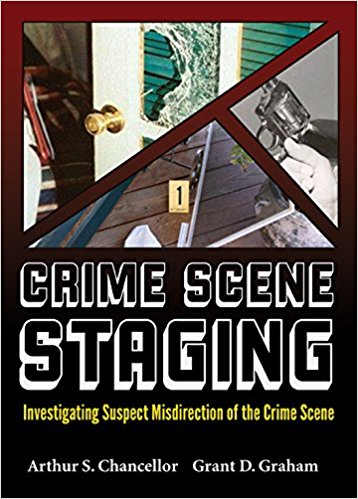
Crime Scene Staging: Investigating Suspect Misdirection of the Crime Scene
This unique text has been written as a practical reference for detectives, crime scene investigators, and prosecutors on how to recognize a staged scene and how this offender behavior could be used as evidence in subsequent trials. The book is designed to help those actively engaged in conducting criminal investigations identify the red flags or those common findings at a crime scene that point to the scene being staged or altered and thereby assist the investigative process. The text is not only research based but also includes the authors’ 30-year experience and personal observations in conducting hundreds of different crime scene investigations ranging from homicide and death, burglary and other property crimes, to rape other and sexual crimes.
Prior to retiring from the Pennsylvania State Police, I served as the Supervisor of the Criminal Investigation Assessment Unit, as well as departmental representative as a subject matter expert in many areas, including Crime Scene Assessment and Crime Scene Staging….. I feel that this is a must read for all law enforcement and prosecutors and have added this book to my recommended reading list in all of my future training.
Patrick J. Zirpoli, Pennsylvania State Police, Ret./Investigative Sciences Journal/Volume 9/Number 1/March 2017
Melissa Fernandez
Death Investigations (The 2nd Edition)
D. Pauly, Special Agent (Ret.), Associate Professor/Director Applied Forensic Science, Methodist University, Fayetteville
Investigating Sexual Assault Cases (2nd Edition)
Mass LEO/Amazon Book Review
– Arthur S. Chancellor
– Grant D. Graham Sr.
Cold Cases: An Evaluation Model with Follow-up Strategies for Investigators
This second edition features a new revised model and methodology for investigating cold cases suitable for all police and public safety agencies―large or small, domestic or international. This new model is more expeditious and convenient for departments that have less manpower and experience in dealing with cold cases.
Mass LEO/Amazon Book Review
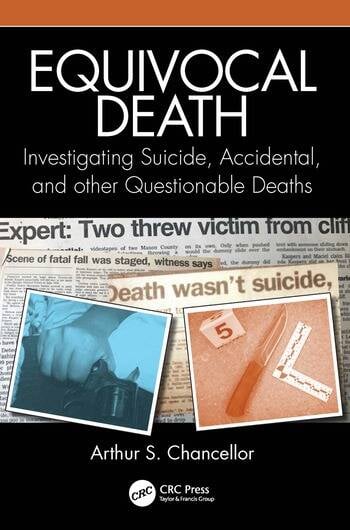
Equivocal Death: Investigating Suicide, Accidental and other Questionable Deaths
(A. Chancellor)
This unique text refocuses the attention of first responders and investigative personnel to the concept of treating every death as a homicide, until sufficient evidence is discovered to validate another manner of death and eliminate the possibility of a staged homicide.
All death investigations should include a well-documented and examined crime scene and a thorough preliminary investigation. It is a well-established, unwritten “rule” when conducting death investigations to initially treat every death as a possible homicide. This includes the examination of the body, the recovery scene, the autopsy, collection of forensic evidence, and subsequent laboratory analysis. Police and investigators are often confronted with a death scene that they cannot initially determine the manner of death; these instances are known as equivocal death.
Coverage focuses on the basics of death investigation and the how to’s rather than dwelling on extraneous and unnecessary detail. By example, it is generally more important for the detective or CSI to understand how to properly pick up forensic evidence at the scene, and how the resulting analysis relates to their investigation, rather than the mechanics of how the evidence is extracted and analyzed at the lab. For suicide and equivocal deaths, it is likewise important that detectives also understand the importance of such things as a victimology assessment, risk factors, and/or ante mortem behaviors of the victim, cues that may provide clues that would be consistent with someone contemplating suicide. The book also features several aspects of criminal investigation that are not found in similar books, including coverage of victimology, including crime scene staging, the notion of psychology autopsy, and how to identify those risk factors or behaviors that are consistent with suicide including motive, intent, and ability.

Child Abuse Investigations: From Dispatch to Disposition
(D. A. Hayden)
For investigators, the emphasis of traditional forensics (the science of the crime scene) has resulted in the loss of deductive reasoning skills. This book centers on the investigator’s ability to interpret and identify non-traditional cues and clues, oftentimes seemingly ‘innocent’ actions, through the investigator’s deductive reasoning skills. If the investigator can interpret these items and understand their evidentiary value and how this information becomes evidence of the crime itself, an investigation is more likely to have a positive outcome. Separated into five sections, the first section defines the roles, goals and outcomes. The next section pertains to the psychological aspects of the parties involved, including the victim, the suspect, and the non-offending parents. The third section concentrates on the investigation. This section addresses and discusses court rulings and significant cases (e.g. Crawford v. Washington). This is followed with interview methodologies and some leading interview guidelines. The crime scene is discussed in the next section. The fourth section reviews the court process, and the final section addresses the impact of long-term exposure to child abuse on team members. The book includes chapter summaries and numerous actual case examples of some of the more well-known and high profile investigations. At the end of each chapter is a list of key terms along with critical thinking questions for the reader to analyze and provide answers to the presented problems. The book will be an invaluable resource to law enforcement, child protective services, medical personnel, courts, and child advocates.

Crime Scene Processing Laboratory Manual and Workbook
(D. A. Hayden)
Crime Scene Processing Laboratory Manual and Workbook serves as the laboratory course complement to Ross Gardner’s Practical Crime Scene Processing and Investigation. Developed through Hayden’s own course on crime scene investigation, it is designed to teach the basics of crime scene documentation, as well as evidence identification, preservation, and collection. Standing on its own, the workbook is also useful for self-instruction and as seminar curriculum.
This multi-purpose manual contains fifty exercises, including practical hands-on experiments such as evidence packaging, in addition to workbook exercises. Advice on report writing and suggestions for research papers are also provided. The manual includes a variety of documentary exercises not found in other resources such as mapping a crime scene, developing a crime scene response kit, preparing an evidence voucher, and sketching a crime scene.
With a variety of exercises simulating actual tasks, this laboratory manual helps build the skills required to properly document and process a crime scene. When the exercises are complete, it becomes a useful reference that can be revisited and relied upon throughout a career.

Homicide: Guidelines for Conducting Homicide Investigations by Detectives - for Detectives
(J. Adcock; A.S. Chancellor; W. Doogan; L. Eliopulos; T. Keel; J.K. Smith; S. Wolter; P. Zirpoli; J. Holmes; L. Wagner)
Contains step by step guidelines for the conduct of homicide investigations, prepared by detectives for detectives. Includes a detailed checklist for detectives and for homicide supervisors, a short checklist to guide them through the review process.
This book provides a thorough list for process for a homicide. This is a great book for a new detective, new supervisor, or someone at an agency that does not get many homicides. For someone with more experience it may be a bit basic but it would be handy to reference to ensure a task was not missed.
Amazon Book Review
Articles and Podcasts
Article: Crime Scene Staging, Crime Scene Clues to Suspect Misdirection of the Investigation
Article: “I’ve been shot!” Or maybe not.” Texas District & County Attorney’s Assoc., The Texas Prosecutor, Jan-Feb 2017, Vol. 47, Iss. 1
Article: Sandra Melgar guilty of killing husband, faking home invasion on Houston couple’s anniversary night.
Article: Investigating Sexual Assault Cases: Article from the Military Police Regimental Association Magazine (Winter 2018, Vol 28, No 3)
Article: Fayetteville Police Forensic Manager (Grant Graham) Co-Authors Crime Scene Staging Book
Forensic Files: Army of Evidence (Steve Chancellor is featured in a previously determined suicide case reinvestigated as a homicide)
Podcast: Inside the Badge (Grant Graham and Steve Chancellor speak about crime scene staging with Dr. Carlos Vazquez)
Podcast: Solving Cold Cases (Grant Graham talks with Dr. Jim Adcock about crime scene processing and cold case investigations) Aug 28, 2019
Podcast: Solving Cold Cases (Steve Chancellor speaks with Dr. Jim Adcock about crime scene staging and cold case investigations) Sep 4, 2019